|
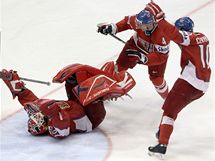
So far, fans think Karel Rachůnek's
goal from 2010 is most worthy of
celebrating. Photo: Francis Larrede.
|
The selection is obviously limited to those in the television age, otherwise it would surely include Augustin Bubnik's game-winner in the last game of the 1949 World Championship, which gave Czechoslovakia its first-ever win over Canada and second gold medal.
All of the goals can be watched and voted on at http://www.ceskatelevize.cz/mshokej/historie/174481-nejslavnejsi-gol/ . Below is a summary of all ten finalists. As is done on the website, they are presented chonologically:
Miroslav Vlach (1959, ČSR - Canada)
Heading into the very last game of the tournament, in Prague, Canada had effectively sewn up the gold medal, as only a defeat of five goals or more could unseat them. The host Czechoslovaks, however, needed a two-goal victory to reach the bronze medal. Late in the third period, with the home team ahead 4-3, Canada pulled its goalie to go for the tie. Vlach scored from centre ice into the empty net to give his team the two-goal margin it needed to earn a medal on home ice.
Though it was only an empty-netter to achieve a bronze, it likely makes the top ten due to the first-hand memory of many fans in attendance, as well as the fact that it was the first World Championship to be televised in Czechoslovakia.
Josef Černý (1969 World Championship, ČSSR - USSR)
Seven months after the Soviet-led occupation of Czechoslovakia, the national hockey teams of the two nations faced each other at the World Championship in Stockholm. Leading 1-0 in the third period, Černý, a defenceman, led a brilliant individual rush from his own side of centre in which he made a nice move to beat a Soviet defenceman and then backhanded the puck past goaltender Viktor Zinger. The Czechoslovaks won the game 2-0, then beat the Soviets again by a 4-3 score seven days later.
In the end, the Soviet Union, Sweden and Czechoslovakia finished tied in points. The Soviets ended up with the gold and the Czechoslovaks the silver, but it was the first time that any country had defeated the Soviet Union twice in a single tournament.
Jaroslav Holík (1972 World Championship, ČSSR - USSR)
With two games for each team left, Czechoslovakia and the Soviet Union faced off at Prague's Sportovní hala tied in points. The Czechoslovaks fell behind 2-1 early in the second period but came back to tie it, then Holík beat Vladislav Tretiak with a wrist shot from the high slot for the eventual game-winner.
Two days later, an easy 8-2 win over Finland clinched Czechoslovakia's first gold medal since 1949.
Milan Nový (1976 Canada Cup, ČSSR - Canada)
Despite being World Champions, the players on the Czechoslovakian national team were virtually unknown in North America when the arrived to compete against NHL players and the top national teams of Europe in the Canada Cup. Late in the round-robin stage, the tournament's last two unbeaten teams, Czechoslovakia and Canada, met at the famous Montreal Forum. The goaltending duel between Vladimír Dzurilla and Rogatien Vachon was finally solved with less than five minutes remaining, when Nový scored the game's only goal.
The two teams would meet again in the tournament final and this time Canada prevailed, but not before the Czechoslovakian players made themselves known to Canadian hockey fans.
Bohuslav Ebermann (1977 World Championship, ČSSR - Sweden)
In their second-last game of the 1977 tournament, the defending champions from Czechoslovakia were tied 1-1 with Sweden late in the third period. Ebermann beat at Swedish defenceman to the outside and then cut in to score the go-ahead goal, putting them in the driver's seat to repeat as gold medalists.
Two days later, they could have clinched gold with a win over Canada, but lost 8-2. That meant that they needed Sweden to beat the Soviet Union in the last game to retain first place, which they did.
Jiří Šejba (1985 World Championship, ČSSR - Canada)
In 1985, Prague was once again the host of the World Championships. On the last day, Czechoslovakia faced Canada with the gold medal on the line. Midway through the second period, the host team led 2-1, with Šejba scoring twice. Canada was on the power play, however, and pressing for the equalizer.
Shorthanded, Šejba picked up the puck at his own blueline and raced down the ice, dodged a diving Canadian defenceman and then eluded a poke-check attempt by the goalie to complete his hat trick. Czechoslovakia went on to win 5-3 and capture the gold medal.
Martin Procházka (1996 World Championship, ČR - Canada)
In their first gold medal game since the dissolution of Czechoslovakia, the Czech Republic faced Canada for the gold medal in Vienna. Tied 4-4 late in the game's final minute, the Czechs skated into the Canadian zone, where Procházka took a pass from Pavel Patera and beat goalie Curtis Joseph to the glove side.
An empty-net goal in the dying seconds gave the Czech Republic a 6-4 win and the gold medal.
Petr Svoboda (1998 Winter Olympics, ČR - Russia)
In the long hockey history of Czech hockey, the nation had never won an Olympic gold medal, although twice they were beaten out of one by the Soviet Union in the final game. In Nagano in 1998, they faced Russia in the final. Still scoreless almost midway throug the third period, a faceoff win in the attacking zone by Patera was worked back to Svoboda, who had time to tee up a big slapper and beat Andrei Trefilov for the game's only goal.
Need anything be said about the aftermath of this? Though it was early morning in the Czech Republic, fans across the country erupted in celebration, and the team itself arrived that evening to celebrate what is probably the defining moment in the nation's sporting history.
David Moravec (2001 World Championship, ČR - Finland)
The Czech Republic was two-time defending champions at the 2001 World Championship in Germany, and found themselves in the gold medal game, looking for a third. Tied 3-3, the game against Finland went to overtime, and after almost 11 minutes of extra time, Moravec's backhander from in close found the back of the net, giving the Czechs their "golden hat trick".
Karel Rachůnek (2010 World Championship, ČR - Sweden)
After a shootout win in the quarterfinals against Finland, the Czech Republic faced Sweden in the semifinals at the 2010 worlds in Cologne, Germany. In the dying seconds of the third period, trailing 2-1, the puck came out from behind the net and Rachůnek one-timed it toward the goal and it went in with only eight seconds on the clock.
The Czechs ultimately won the game in a shootout and, the next day, they won the gold medal with a 2-1 victory over Russia.
The fan vote is anything but dramatic, with Rachůnek's goal the runaway winner, currently carrying 74 percent of the vote. The popularity of this goal is doubtlessly buoyed by the untimely demise of the popular defenceman in the tragic Lokomotiv Yaroslavl airline disaster last September, as well as the fact that is is the most recent goal on the list, and therefore freshest in the minds of most fans.
In a distant second place is Svoboda's goal from 1998, with 13%.