Showing posts with label Czech Hockey Legends. Show all posts

Saturday, June 9, 2012

Zlatá hokejka time again

It's almost time once again for the awarding of the Zlatá hokejka, the Golden Stick, to the best Czech hockey player of the past season, regardless of where in the world he played. Ten finalists have been announced, and on June 23, some of the best Czech hockey players in the world, along with other important and well-dressed people will gather at the prestigious Grand Hotel Pupp in Karlovy Vary to crown this year's winner.

Will Patrik Eliáš win his 2nd Zlatá
hokejka? Photo: James Teterenko
For me, this is the second Zlatá hokejka campaign that I have followed closely. Last year, based on the list of ten finalists, I concluded that David Krejčí of the Boston Bruins should have been the winner. Had the vote not taken place before the Final, he still might have been, but I figured he had still done enough to win, considering he was leading the Stanley Cup playoff scoring race. Coming from a Vancouver Canucks fan, fresh off an excruciating defeat, that was a bold prediction. But I forgot to factor something in.

That something is, if Jaromír Jágr has a chance of winning, he will.

Last year, he had 50 points in 49 games with Avangard Omsk of the Kontinental Hockey League before leading them to a defeat in the Gagarin Cup quarterfinals. In the World Championship, he turned on the gas, recording 9 points in nine games, including his first-ever hat trick for the Czech national team, en route to a bronze medal. A fine season, to be sure, but was it the finest of any Czech hockey player that year? I say no, but then, I'm not Czech.

The question this year is, does Jágr have a chance of winning his unprecedented 11th award? Returning to the NHL, he recorded 54 points in 73 regular season games, then 8 points in 11 points, as the Philadelphia Flyers were eliminated in the second round. He declined an invite to play in the World Championships after his team was finished, which may take him out of the running, as so much weight seems to be given by voters to success in that tournament.

So, if not Jágr, then who? The next group of players after him to look at are those from the so-called Zlatá generace (Golden Generation), the group of players that formed the core of the team that won five World Championships and one Olympic gold medal between 1996 and 2005. Though it can be debated exactly which players belong in that class, one player in the top 10, Patrik Eliáš, is certainly a member. This past season, at age 36, Eliáš recorded 78 points in 81 games for the New Jersey Devils, which made him far and away the most productive Czech in the NHL, 16 points ahead of Krejčí and Radim Vrbata. In fact, Eliáš's season isn't even finished yet, as his Devils are currently playing in the Stanley Cup Final. Eliáš has won previously, in 2009.

Of course, New Jersey's playoff success kept Eliáš from playing in the World Championship. However, despite the Czech Republic's bronze-medal finish, the team lacked an outstanding individual performance that they got in 2011 from Jágr and Ondřej Pavelec, who is again a finalist this year. Somewhat surprisingly, goaltender Jakub Kovář did not make the cut this year. The only World Championship players in the top 10 are Martin Erat, Milan Michálek, Petr Nedvěd and Tomáš Plekanec. Plekanec registered 7 points in 10 games, while Erat arrived midway through and got 4 points in five games.

Nedvěd might be a sentimental choice, as he led the Czech Extraliga in scoring at age 40, and also recorded 13 points in 21 games internationally, his first time representing the land of his birth since 1996. I'll slide him into the #2 spot behind Eliáš, however, as no Extraliga player has won the award since Jiří Dopita in 2001.

So that settles it, Eliáš will definitely probably win.

Below are a list of the ten finalists, followed by past winners of the award:

Roman Červenka     C       Avangard Omsk (KHL)
Patrik Eliáš       C/LW    New Jersey Devils (NHL)
Martin Erat        L/RW    Nashville Predators (NHL)
Jaromír Jágr       RW      Philadelphia Flyers (NHL)
Milan Michálek     L/RW    Ottawa Senators (NHL)
Petr Nedvěd        C       Bílí Tygři Liberec (ELH)
Ondřej Pavelec     G       Winnipeg Jets (NHL)
Tomáš Plekanec     C       Montreal Canadiens (NHL)
Jakub Voráček      RW      Philadelphia Flyers (NHL)
Radim Vrbata       R/LW    Phoenix Coyotes (NHL)

Past Winners:

1969 - Jan Suchý
1970 - Jan Suchý
1971 - František Pospíšil
1972 - František Pospíšil
1973 - Vladimír Martinec
1974 - Jiří Holeček
1975 - Vladimír Martinec
1976 - Vladimír Martinec
1977 - Milan Nový
1978 - Ivan Hlinka
1979 - Vladimír Martinec
1980 - Peter Šťastný
1981 - Milan Nový
1982 - Milan Nový
1983 - Vincent Lukáč
1984 - Igor Liba
1985 - Jiří Králík
1986 - Vladimír Růžička
1987 - Dominik Hašek
1988 - Vladimír Růžička
1989 - Dominik Hašek
1990 - Dominik Hašek
1991 - Bedřich Ščerban
1992 - Róbert Švehla
1993 - Miloš Holaň
1994 - Roman Turek
1995 - Jaromír Jágr
1996 - Jaromír Jágr
1997 - Dominik Hašek
1998 - Dominik Hašek
1999 - Jaromír Jágr
2000 - Jaromír Jágr
2001 - Jiří Dopita
2002 - Jaromír Jágr
2003 - Milan Hejduk
2004 - Robert Lang
2005 - Jaromír Jágr
2006 - Jaromír Jágr
2007 - Jaromír Jágr
2008 - Jaromír Jágr
2009 - Patrik Eliáš
2010 - Tomáš Vokoun
2011 - Jaromír Jágr

Most Wins:

10 - Jaromír Jágr
5 - Dominik Hašek
4 - Vladimír Martinec
3 - Milan Nový

Thursday, May 17, 2012

The biggest Czech goal of all time?

So far, fans think Karel Rachůnek's
goal from 2010 is most worthy of
celebrating. Photo: Francis Larrede.
For those who have been following Česká Televize's coverage of the IIHF World Championships, you are probably already familiar with the Nejslavnější gól (Most Celebrated Goal) campaign, in which a selection of the top ten goals in Czech and Czechoslovak international hockey history are profiled throughout the tournament, with fans able to vote for the winner on the internet.

The selection is obviously limited to those in the television age, otherwise it would surely include Augustin Bubnik's game-winner in the last game of the 1949 World Championship, which gave Czechoslovakia its first-ever win over Canada and second gold medal.

All of the goals can be watched and voted on at http://www.ceskatelevize.cz/mshokej/historie/174481-nejslavnejsi-gol/ . Below is a summary of all ten finalists. As is done on the website, they are presented chonologically:


Miroslav Vlach (1959, ČSR - Canada)

Heading into the very last game of the tournament, in Prague, Canada had effectively sewn up the gold medal, as only a defeat of five goals or more could unseat them. The host Czechoslovaks, however, needed a two-goal victory to reach the bronze medal. Late in the third period, with the home team ahead 4-3, Canada pulled its goalie to go for the tie. Vlach scored from centre ice into the empty net to give his team the two-goal margin it needed to earn a medal on home ice.

Though it was only an empty-netter to achieve a bronze, it likely makes the top ten due to the first-hand memory of many fans in attendance, as well as the fact that it was the first World Championship to be televised in Czechoslovakia. 


Josef Černý (1969 World Championship, ČSSR - USSR)

Seven months after the Soviet-led occupation of Czechoslovakia, the national hockey teams of the two nations faced each other at the World Championship in Stockholm. Leading 1-0 in the third period, Černý, a defenceman, led a brilliant individual rush from his own side of centre in which he made a nice move to beat a Soviet defenceman and then backhanded the puck past goaltender Viktor Zinger. The Czechoslovaks won the game 2-0, then beat the Soviets again by a 4-3 score seven days later.

In the end, the Soviet Union, Sweden and Czechoslovakia finished tied in points. The Soviets ended up with the gold and the Czechoslovaks the silver, but it was the first time that any country had defeated the Soviet Union twice in a single tournament.


Jaroslav Holík (1972 World Championship, ČSSR - USSR)

With two games for each team left, Czechoslovakia and the Soviet Union faced off at Prague's Sportovní hala tied in points. The Czechoslovaks fell behind 2-1 early in the second period but came back to tie it, then Holík beat Vladislav Tretiak with a wrist shot from the high slot for the eventual game-winner.

Two days later, an easy 8-2 win over Finland clinched Czechoslovakia's first gold medal since 1949.


Milan Nový (1976 Canada Cup, ČSSR - Canada)

Despite being World Champions, the players on the Czechoslovakian national team were virtually unknown in North America when the arrived to compete against NHL players and the top national teams of Europe in the Canada Cup. Late in the round-robin stage, the tournament's last two unbeaten teams, Czechoslovakia and Canada, met at the famous Montreal Forum. The goaltending duel between Vladimír Dzurilla and Rogatien Vachon was finally solved with less than five minutes remaining, when Nový scored the game's only goal.

The two teams would meet again in the tournament final and this time Canada prevailed, but not before the Czechoslovakian players made themselves known to Canadian hockey fans.


Bohuslav Ebermann (1977 World Championship, ČSSR - Sweden)

In their second-last game of the 1977 tournament, the defending champions from Czechoslovakia were tied 1-1 with Sweden late in the third period. Ebermann beat at Swedish defenceman to the outside and then cut in to score the go-ahead goal, putting them in the driver's seat to repeat as gold medalists.

Two days later, they could have clinched gold with a win over Canada, but lost 8-2. That meant that they needed Sweden to beat the Soviet Union in the last game to retain first place, which they did.

Jiří Šejba (1985 World Championship, ČSSR - Canada)

In 1985, Prague was once again the host of the World Championships. On the last day, Czechoslovakia faced Canada with the gold medal on the line. Midway through the second period, the host team led 2-1, with Šejba scoring twice. Canada was on the power play, however, and pressing for the equalizer.

Shorthanded, Šejba picked up the puck at his own blueline and raced down the ice, dodged a diving Canadian defenceman and then eluded a poke-check attempt by the goalie to complete his hat trick. Czechoslovakia went on to win 5-3 and capture the gold medal.


Martin Procházka (1996 World Championship, ČR - Canada)

In their first gold medal game since the dissolution of Czechoslovakia, the Czech Republic faced Canada for the gold medal in Vienna. Tied 4-4 late in the game's final minute, the Czechs skated into the Canadian zone, where Procházka took a pass from Pavel Patera and beat goalie Curtis Joseph to the glove side.

An empty-net goal in the dying seconds gave the Czech Republic a 6-4 win and the gold medal.


Petr Svoboda (1998 Winter Olympics, ČR - Russia)

In the long hockey history of Czech hockey, the nation had never won an Olympic gold medal, although twice they were beaten out of one by the Soviet Union in the final game. In Nagano in 1998, they faced Russia in the final. Still scoreless almost midway throug the third period, a faceoff win in the attacking zone by Patera was worked back to Svoboda, who had time to tee up a big slapper and beat Andrei Trefilov for the game's only goal.

Need anything be said about the aftermath of this? Though it was early morning in the Czech Republic, fans across the country erupted in celebration, and the team itself arrived that evening to celebrate what is probably the defining moment in the nation's sporting history.


David Moravec (2001 World Championship, ČR - Finland)

The Czech Republic was two-time defending champions at the 2001 World Championship in Germany, and found themselves in the gold medal game, looking for a third. Tied 3-3, the game against Finland went to overtime, and after almost 11 minutes of extra time, Moravec's backhander from in close found the back of the net, giving the Czechs their "golden hat trick".


Karel Rachůnek (2010 World Championship, ČR - Sweden)

After a shootout win in the quarterfinals against Finland, the Czech Republic faced Sweden in the semifinals at the 2010 worlds in Cologne, Germany. In the dying seconds of the third period, trailing 2-1, the puck came out from behind the net and Rachůnek one-timed it toward the goal and it went in with only eight seconds on the clock.

The Czechs ultimately won the game in a shootout and, the next day, they won the gold medal with a 2-1 victory over Russia.


The fan vote is anything but dramatic, with Rachůnek's goal the runaway winner, currently carrying 74 percent of the vote. The popularity of this goal is doubtlessly buoyed by the untimely demise of the popular defenceman in the tragic Lokomotiv Yaroslavl airline disaster last September, as well as the fact that is is the most recent goal on the list, and therefore freshest in the minds of most fans.

In a distant second place is Svoboda's goal from 1998, with 13%.

Saturday, December 3, 2011

Ambitious Project

A Czech hockey fan in the United States is working on the ambitious project of trying to document as many players as possible who defected from Communist Czechoslovakia to North America between 1948 and 1989. To make this task even more daunting, he is not including NHL or WHA players "not because I'm not interested but because their stories are generally pretty well documented."

Personally, I've never heard of most of the players on the list and certainly can't help add to it, but perhaps some readers could help. If you read more of Greg D'Avis' blog, The Post-Pessimist Association, you will find he is working on other projects related to Czech hockey as well, including information on the post-playing careers and current status of several players.

Here is the list of players he has compiled so far:

Jiří Bastl -- Fringe player for Sparta Praha and Kladno in the 1960s. Defected late that decade, apparently to West Germany at first (though details are sketchy). Made his way to North America where he attended a Blackhawks training camp and played in the IHL, then went back to Germany. Coached for a while. Now lives in Switzerland, and is (I think, again) the father of tennis player George Bastl.

Kristián Cee -- Sparta defenseman of the 1940s and 1950s. Became a doctor during his playing days. Post-career, traveled to Western Europe through Yugoslavia in 1966, settling in West Germany. Returned to the Czech Republic after the fall of Communism, and died last year.

Jaroslav Drobný -- Now here's a guy worth looking into: a forward for I. ČLTK Praha, he was also a tennis star and defected at a 1949 tournament. He got Egyptian (sure, why not?) citizenship, won the 1954 Wimbledon men's singles tournament, and eventually settled in Britain. He died there in 2001.

Jiří Hanzl -- uncertain on this one, but I think that post-career, the Sparta goalie defected to West Germany. He definitely ended up coaching there for a while.

Petr Hejma -- 1968 Olympian, forward for Sparta Praha. Defected to West Germany following a Sparta exhibition match in September 1968. Played many years for Düsseldorf and Krefeld, still lives in Germany.

Zdeněk Hlásek -- Sparta forward during the 1950s. Not sure of the date but defected in the 1960s. Still lives in Switzerland, and like Bastl his son ended up a professional tennis player.

Jiří Kren -- Sparta forward, defected during the 1963 Spengler Cup. Played in the Canadian minor leagues for a season then back to Germany and Switzerland. I exchanged letters with him a few years ago; he was making wine in northern Italy, which does not sound half bad.

Oldřich Kučera -- 1936 Olympian, longtime LTC Praha forward. Post-career details are scant, but by 1949 he was coaching in Switzerland, and reportedly eventually ended up in Australia.

Viktor Lonsmín -- covered at length here.

Martin Maglay -- 1970s junior goalie, fled along with or around the same time as Jiří Crha. Ended up in the Maple Leafs system but it's unclear if he ever played; he was beaten up during a mugging and that effectively ended his career. Runs hockey school programs in Ontario.

Zdeněk Marek -- forward for ATK Praha and Sparta, defected at 1949 World Championships. Played at least one season for the University of North Dakota; I don't know if he played any organized hockey after that. Lived in New York for a long time. Reportedly passed away in 2009, though that's strangely hard to confirm.

Stanislav Nepomucký -- Sparta defenseman in the 1950s. Defected during an exhibition tour in 1958. Played at least one season for HIJS Den Haag in the Netherlands; eventually ended up in the United States and changed his last name to "Nielsen." Passed away in 2006.

Jiří Petrnoušek -- Sparta youngster, defected to the Netherlands in 1968 at age 21. Played for Tilburg for a very long time and represented the Dutch in the 1980 Olympics. Think he still lives there.

Jiří Pokorný -- defected late 1960s, date unclear, not clear if he was currently active when it happened. Wound up as player-coach for Tilburg in Netherlands in 1969-70, then coached in Netherlands and West Germany through the 1970s. I'm still looking for more information on him, by the way.

Miloslav Pospíšil -- Forward for ATK Praha, Tatra Smichov, and Sparta. Wound down his career in the early 1960s, fled to Austria in 1968. Eventually wound up in North America, and lived in New York until his death in 2000.

Rudolf Šindelář -- Sparta forward from the late '50s through the '70s. Escaped to Austria (I think) at some point post-career. Now lives back in the Czech Republic.

Miroslav Sláma -- Fellow I don't know much about -- I. ČLTK Praha defenseman, 1948 Olympian. According to notes on the Society for International Hockey Research website, he defected during the 1948 Spengler Cup tournament and spent several years playing and coaching in Switzerland. Ended up in the U.S., died in California in 2008.

Zdeněk Tikal -- Brother of Czech legend František. Not sure what level Zdeněk played at in Czechoslovakia -- I haven't turned up any records with major teams. Went to Australia with his father in 1948, played on the Australian national team in the 1960 Olympics. Died in 1991.

Jaroslav Tůma -- Like Petrnoušek, another Sparta youngster, may have defected at the same time. Ended up with Tilburg (along with Petrnoušek and Pokorný), where he put up frankly ridiculous numbers. Went to West Germany after a few years and still did well; eventually wound up in Switzerland, I think.

Ivo Veselý -- Like Zdeněk Tikal, I know nothing about his Czechoslovak career -- like ZT, went to Australia and ended up on the 1960 team. Died 2002.

Oldřich Zabrodský -- Brother of Vladimír (see below). Forward for LTC Praha, fled to Switzerland in 1948, where he played for Davos and Lausanne for a few years. Lived in Belgium last I knew.

Vladimír Zábrodský -- Legendary forward for LTC Praha and Sparta, subject of much controversy. Escaped to Sweden at some point. Still lives there.

Greg D'Avis can be followed on Twitter @gsdgsd.

Friday, December 2, 2011

Nový elected to IIHF Hall of Fame

The International Ice Hockey Association announced on Friday its list of inductees to the International Hockey Hall of Fame  for 2012, and among them is former Czech great Milan Nový.

Nový at the 1976 Canada Cup. Photo: tm50.
Nový was one of international hockey's greatest stars of the 1970s; some hailed him as the best centre in the world at the time. He was the biggest star during Czechoslovakia's run of back-to-back World Championships in 1976 and 1977, scoring 36 points over 14 games in those two tournaments. Over his career, he scored 122 goals in 214 games with the national team.

The Kladno native became a noted name among North American hockey fans at the 1976 Canada Cup, where he helped lead Czechoslovakia into the tournament final with 8 points in seven games, which included scoring the lone goal in a 1-0 victory over Canada during the round-robin phase of the tournament. He was named to the tournament all-star team at centre.

Domestically, he played at the top level of Czechoslovakian hockey from 1968 to 1982 and 1986 to 1989 for Kladno and Jihlava, where he scored 594 career goals. His most impressive season was 1976-77, when he scored 59 goals in only 44 games for Kladno. He also played one season for the NHL's Washington Capitals in 1982-83 and briefly for Swiss club Zürich SC Lions and Austrian club Wiener EV before ruturning home.

For more on Nový's life and career, visit his profile at GreatestHockeyLegends.com.

Other inductees are Russian Pavel Bure, Finn Raimo Helminen, American Phil Housley, and Canadian coach Andy Murray.

From IIHF.com, here is a list of Czechs that have previously been inducted into the Hall:


PLAYER
BORN
INDUCTED
CATEGORY
Quido Adamec
1924
2005
Referee
Vladimír Bouzek
1920
2007
Player
Vlastimil Bubník
1931
1997
Player
Luděk Bukač
1935
2007
Builder
Josef Černý
1939
2007
Player
Jaroslav Drobný
1921
1997
Player
Karel Gut
1927
1998
Player
Ivan Hlinka
1950
2002
Player
Jiří Holeček
1944
1998
Player
Jiří Holík
1944
1999
Player
Vladimír Kostka
1922
1997
Builder
1944
1999
Player
Josef Maleček
1903
2003
Player
Vladimír Martinec
1949
2001
Player
Bohumil Modrý
1916
2011
Player
1944
1997
Player
Milan Nový
1951
2012
Player
František Pospíšil
1944
1999
Player
Miroslav Šubrt
1926
2004
Builder
Jan Suchý
1944
2009
Player
František Tikal
1933
2004
Player
Vladimír Zábrodský
1923
1997
Player

Thursday, September 8, 2011

Czechs mourn the loss of Marek, Rachůnek, Vašiček

"This is the darkest day in the history of our sport. This is not only a Russian tragedy, the Lokomotiv roster included players and coaches from ten nations."

Patrik Eliáš was among the many mourners who attended a
memorial at Prague's Old Town Square for the victims of the
Yaroslavl disaster. Photo: Barbora Reichova, isport.blesk.cz.
Those were the words of IIHF President René Fasel in the aftermath of Wednesday's airline disaster that wiped out the Lokomotiv Yaroslavl team. Indeed, one has to go back 60 years to find a disaster that was as devastating to a hockey team: the 1951 crash that killed almost all of the VVS Moscow team.

Though they were similar in that they were elite-level Russian teams and killed almost all players of each, there are some things that separate them. The 1951 disaster included only Soviet players and the communication limitations and political situation of the time meant that events were not immediately available to the public. Indeed, it would take decades for many of the details to be released.

Though the majority of the 43 people lost on Wednesday were Russian, there were, as Fasel stated, ten nations that felt the effects. The effect was felt immediately, too. Within half an hour of the plane going down, it was headlining news around the world. After Russia, that effect was probably felt the most in the Czech Republic.

Literally within minutes of the story breaking, the outpouring of emotions from Czechs was noticeable. Condolences were posted on social networks, with impromptu vigils being arranged everywhere.

"The news was shocking for all of us," began Czech Ice Hockey Association President Tomáš Král. "Jan Marek, Karel Rachůnek and Josef Vašiček played key roles on the biggest successes of our hockey in recent years, particularly at the World Championships in 2005 and 2010. They were not just great hockey players, but also excellent friends. We will never forget them."

In a hockey-mad country where the pinnacle of the sport is representing the country in the World Championships or Olympic Games, a gold medalist has achieved immortality. As the headline of newspaper Sport proclaimed, "Zůstanou šampiony" (They Remain Champions). Another read, "Slzy pro tři zlaté chlapce" (Tears for Three Golden Boys).

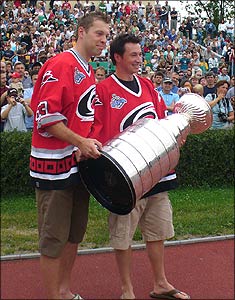
Josef Vašiček (left) and František Kaberle,
with the Stanley Cup in Kladno, 2006. Photo:
Mike Bolt, hhof.com.
At age 30, Josef Vašiček was the youngest of the trio. Hailing from Havlíčkův Brod, he struck gold as a junior, being a member of the 2000 World Junior Championship team. Vašiček played junior hockey with the Sault Ste. Marie Greyhounds of the Ontario Hockey League and then 460 games in the NHL, mostly with the Carolina Hurricanes. During the 2004-05 NHL lockout, he played in the Czech Extraliga for Sparta Praha, and then was a member of the Czech Republic's 2005 World Championship in Vienna. He experienced even more success a year later, as a member of Carolina's Stanley Cup championship team. A big centreman, Vašiček was intelligent and played well at both ends of the rink. He went to the KHL in 2008, and was about to begin his fourth season with Yaroslavl.

Karel Rachůnek. Photo: Francis Larrede.
Karel Rachůnek, age 31, was Yaroslavl's captain, and was actually on his third tour of duty with the team. He played for them briefly during the 2002-03 season, again from 2004 to 2006, before rejoining them in 2010. He came from Zlín and played for that club in the Czech Extraliga in the late 90s before going to the NHL, where he played mostly for the Ottawa Senators. A decently-sized, if not large defenceman, Rachůnek developed an offensive touch later in his career. Last season, he led all KHL defencemen with 46 points. One of the videos that most often appeared on Facebook tributes in the aftermath of the disaster was "Rachna Kachna"'s tying goal against Sweden with 8 seconds left in the semifinal at the 2010 World Championships. In the final game, against Russia, he assisted on Tomáš Rolinek's tournament-winning goal, which earned him golden status.

Rachůnek's two brothers, Ivan and Tomáš, both play for Sparta Praha. At a meeting between the three of them this summer, Karel was asked if he would join his brothers in the Czech capital at some point. He answered, "I have a contract for this season, then we'll see. My brothers are trying to pull me back home."

Jan Marek. Photo: Sergei Terentiev.
Jan Marek, 32, was a centre from Jindřichův Hradec. Somewhat undersized by NHL standards, he is the only one of the three to never play in the North American circuit, though he was drafted by the New York Rangers in 2003. He played in the Czech Extraliga for Oceláři Třinec and Sparta Praha, where he won a national championship in 2006, before heading for the Russia. He played four years for Metallurg Magnitogorsk, where he won a European championship in 2008, and one year with CSKA Moscow before signing with Yaroslavl this past summer. In 2008-09, he led the KHL with 35 goals in 53 games. In the 2010 semifinal game where Rachůnek scored the tying goal, it was Marek who scored the shootout winner.

"I talked with Jan Marek fourteen days ago and he told me he just had a baby," Czech national team coach Alois Hadamczik said on Wednesday night. "I told him this could be an opportunity to come back home, considering he'd been abroad for a long time. Now he won't be home anymore."

After all of Wednesday's impromptu memorials, one was arranged at Prague's Staroměstské náměstí (Old Town Square) on Thursday afternoon by the Czech Ice Hockey Association. Thousands braved the less-than-perfect weather to pay their respects. In past years, many of those same people flocked to the same place in ecstasy, celebrating big victories by Czech teams. As Král explained, "We chose Staroměstské náměstí, which is associated with the success that they achieved."

And just in case winning gold medals wasn't enough to immortalize the trio, the ČSLH made it official. It was announced that the numbers 4 (Rachůnek), 15 (Marek) and 63 (Vašiček), the numbers the three players wore when they won gold, will never be worn again on the Czech national team.


Thursday, August 18, 2011

Machač remembered

Last week, I was in Břeclav, reporting on the Ivan Hlinka Memorial Tournament. While most of my attention was on the games, I also tried to keep an eye on what else was going on in the hockey world. Last Wednesday, it was reported that a Czech hockey star from the past, Oldřich Machač (pictured), passed away after a lengthy illness at age 67.

Prior to that night's game between the Czech Republic and Sweden, as fans began sitting down after the playing of the national anthems, the public address announcer began announcing, in Czech, about Machač's passing. Knowing that a moment of silence was about to follow, I returned to my feet. Some Swedish fans behind me, who couldn't understand the announcement, asked me what was happening. I told them, and they asked who it was for. My answer was simply, "A player from the Czechoslovakian national team from the '70s."

My short answer was partly because I assumed they wouldn't know who he was, but partly because, apart from his name and time period when he played, I didn't really know anything either. Of course, Czech hockey fans of a certain age have no such problem. I didn't have to speak to many before I even found some who knew him in person, and apparently he was one hell of a nice guy. I also learned that he was a bruising defenceman with a booming slapshot from the point who starred domestically for Brno and won three World Championship gold medals.

Last December, Joe Pelletier of Greatest Hockey Legends wrote about an interesting piece about the crossing of paths between Machač and Bobby Orr, two great blueliners of their era, following the 1976 Canada Cup. On the ice at the Montreal Forum after the last game, which Canada won in overtime, the players on each team traded sweaters, as was the tradition in international hockey at the time. The two number 4s traded jerseys, and there is a photograph of Orr appearing in Machač's red ČSSR jersey (right).

The article goes on to explore more about Machač's career. His most notable accomplishment may be his 293 international games played for Czechoslovakia, which is second only to the great Jiří Holík.

You can read the full article here:

http://www.greatesthockeylegends.com/2010/12/czech-out-bobby-orr.html

Monday, July 11, 2011

First Czech NHLer dies

Jaroslav Jiřík, the first Czech player and the first player trained in an Eastern Bloc country to play in the NHL, died in a plane crash on Monday at the age of 71.

A star winger in the 1960s with Sokol Kladno and ZKL Brno, as well as with the Czechoslovakian national team, Jiřík was given permission to sign with the St. Louis Blues of the NHL in 1969, at the age of 30. He played only one season in North America, playing most of the season with the Blues' Central Hockey League affiliate in Kansas City. Though he played only three games in the NHL, he earned the distinction of being the first product of an Eastern Bloc hockey program to do so.

Jiřík was born in Vojnův Městec, near Brno, and played in the Moravian capital for most of his hockey career, including five more years after he returned home from the United States. In Czechoslovakia's top league, he played 17 seasons, scoring 300 goals in 450 games. With the national team, he played in 10 World Championships, three of which were also Olympic tournaments, scoring 83 goals in 143 games. He won three silver medals and four bronzes.

After his playing career ended in 1975, he embarked on a lengthy coaching career. He headed several clubs in Czechoslovakia, as well as the Swiss national team and EV Stuttgart in West Germany. The last team he coached was Kometa Brno of the Czech Extraliga, stepping down in 1996.

Besides hockey, flying was a passion of Jiřík's. He was a licensed pilot and flew planes throughout his playing and coaching career; a hobby that continued after retirement. On Monday, he crashed his plane outside of Brno and died.

For more details of Jaroslav Jiřík's life and playing career, read his biography at GreatestHockeyLegends.com.

Saturday, July 2, 2011

Versatile athlete could have had an NHL career, but stayed home because of his family

by Petr Polák
Eurohockey.com

Photo: hokejcb.cz.
When Jiří Lála was 20 years old, he was in his second full season in the Czechoslovakian 1. liga, one of the top hockey leagues in the world at the time, and scored 40 points in 44 games. The next season, 1980-81, he broke the point-a-game barrier for the first time in the jersey of Dukla Jihlava, the Czechoslovakian army team where the best Czechoslovak athletes spent a mandatory two-year term in the army.

Because Jiří was a great hockey player, he earned a place on the roster of the club composed of the best young Czechoslovak players; the team that won the league championship 11 times between 1968 and 1985.

 Lála played right wing on a line with his good friend Jindřich Kokrment, and their playing styles complemented each other well. Lála scored 62 points (40+22) in 44 games to give him 1.4 points per game, the highest average of his career.

That year was a breakthrough season. 1980-81 was the first of 21 consecutive seasons in which he scored at least a point a game. Not surprisingly, it wasn’t long before Lála’s name was called during the NHL Entry Draft.

He had to wait until the fourth round (76th, Québec) of the 1982 draft to be picked because of the world’s political situation. Czechoslovakia fell in the sphere of the Soviet Union’s influence and talented young athletes weren’t able to get approval to leave the country for prestigious contracts in the West. NHL clubs didn’t want to waste a draft pick on a player whose arrival was very uncertain.

But Lála would get lots of chances to play in the NHL and the scouts were really interested in bringing him over, but his road across the Atlantic Ocean never came because of the conditions of emigration from Czechoslovakia. The decision was less difficult to make it for young boys without family. But when the chance to leave Czechoslovakia finally came to Lála, he was already married and had a child.

Even in the mid 80s, when the Velvet Revolution and democracy were just around the corner, Lála couldn’t have known that the political regime would change in his home country soon.  If he left his country for the NHL, it was possible that he might never see his family again.

North America’s loss was a blessing to Czechoslovak hockey fans, who were dazzled for years by Lála’s amazing skills.

In 1989, the revolution in Czechoslovakia (and the whole Eastern Bloc) came true and a new chance for to play abroad came to Jiří, but he was already 30 years old and the NHL door stayed closed.

Lála took a chance in Germany and for eight years played top-level German hockey, first in the Bundesliga and later the DEL. He also tried the Ice Hockey Superleague in Great Britain and the Swiss Nationalliga A. The last years of his career he spent in lower-level leagues in Germany. All along he continued to average at least 1 point per game.

During his career he won lots of team and individual awards. He is a holder of one gold, two silver and one bronze medal from the World Championships, one silver from the Olympic Games (1984, Sarajevo) and the Czechoslovakian league title (1982 with Jihlava). Individually, he was named the best Bundesliga import player and IIHF Directorate Best Forward of the World Championships in 1983. Twice he claimed the Gustav Jaenecke Trophy as the leading scorer in the Bundesliga and three times the Fritz Poitsch Trophy for the league’s top goal scorer. As well, he played in the Bundesliga All-Star Game three times, among other accolades (see player profile at Eurohockey.com).

Overall he scored 760 goals and 839 assists for an amazing total of 1599 points in 1165 games.

A multi-talented athlete who also played football for the Czechoslovakian Youth National Team, his career came to a close on August 23, 2002 in an exhibition game in Regensburg. Lála’s name would probably be more famous if he had played in the NHL, but he says that he doesn’t regret anything.

Currently, Jiří Lála is married for the second time and has two more children. He manages a commercial studio in České Budějovice and says that he’s not thinking about returning to hockey as a manager or coach right now.

That’s the story of Jiří Lála, whom Dominik Hašek once called: "One of the best forwards (he has) ever played against".

Saturday, June 18, 2011

Who will win the Golden Stick?

The Golden Hockey Stick (or Zlatá hokejka) is an annual award presented to the Czech hockey player who had the best season. The player can play anywhere in the world, and contributions to both his club team and the Czech national team can be taken into account. The 2011 winner will be announced on Saturday night at a special ceremony at the Grand Hotel Pupp in Karlovy Vary, beginning at 21:00 Central European Time. It will be televised on ČT1 and webcast at ceskatelevize.cz. More information can be found at zlatahokejka2011.cz.

Following last month's World Championships, a group of panelists voted on who they felt were the ten best Czech hockey players over the past season. Each panelist ranked them one to ten, with the top-ranked player getting 10 points, and the tenth-ranked player getting 1 point. The panel included all 14 Extraliga head coaches, plus coaches from the Czech national men's senior and U20 teams, retired Czech hockey players, and members of the media.

Once the top ten finalists were determined, a second round of voting was conducted, where the panel again ranked the ten remaining players. The result of that second-round vote will be revealed on Saturday.

Here are the ten finalists, listed alphabetically:

 ČERVENKA, ROMAN   Avangard Omsk (KHL)
 ELIÁŠ, PATRIK  New Jersey Devils (NHL)
 HAVLÁT, MARTIN  Minnesota Wild (NHL)
 JÁGR, JAROMÍR  Avangard Omsk (KHL)
 KREJČÍ, DAVID  Boston Bruins (NHL)
 PAVELEC, ONDŘEJ    Atlanta Thrashers (NHL)
 PLEKANEC, TOMÁŠ  Montreal Canadiens (NHL)
 STRAKA, MARTIN   HC Plzeň 1929
 VOKOUN, TOMÁŠ   Florida Panthers (NHL)
 ŽIDLICKÝ, MAREK   Minnesota Wild (NHL)

Of the ten finalists, seven played in the NHL, while two played in the KHL and one, Martin Straka, played at home in the Czech Extraliga. Straka, who has never won the award, would be a sentimental pick, as held the titles of President, General Manager, and team captain and had to deal with a ton of front-office headaches and still finished second in league scoring. He would be the first domestic player to win the award since Jiří Dopita in 2001.

The two KHL players, Roman Červenka and Jaromír Jágr, were linemates in Omsk. Jágr, who with nine Golden Sticks has won the award more than any other player in history, surely made his way up the voting with his performance in the World Championship, where he registered 9 points in nine games.

Jágr is one of three finalists who have won the award before. The others are the past two winners: Tomáš Vokoun and Patrik Eliáš. Like Jágr, Eliáš's presence in the Top Ten is likely aided by his World Championship performance, where he also recorded 9 points in nine games. Vokoun, on the other, hand, won the award last season based on his performance at the Worlds, but his refusal to play this season will likely prevent him from repeating. The other goaltender on the list, Ondřej Pavelec, was spectacular in goal in the Worlds, but may not have had enough of a spectacular regular season to top the voting.

Eliáš, along with Martin Havlát and David Krejčí, would seem to be the three favourites to win. The trio finished tied with 62 points to lead all Czech players in the NHL. While Eliáš and Havlát starred in the World Championship, Krejčí won the Stanley Cup as a member of the Boston Bruins and led all playoff scorers with 23 points in 25 games.

In total, 58 players received votes:

11. Tomáš Vlasák (Plzeň) 212 points, 12. Dominik Hašek (Spartak Moscow, KHL) 181, 13. Karel Rachůnek (Yaroslavl, KHL) 178, 14. Martin Růžička (Třinec) 170, 15. Milan Hejduk (Colorado, NHL), 129, 16. Jakub Štěpánek (St. Petersburg, KHL) 124, 17. Zbyněk Michálek (Pittsburgh, NHL) 108, 18. Tomáš Rolinek (Magnitogorsk, KHL) 83, 19. Milan Michálek (Ottawa, NHL) 76, 20. Tomáš Kaberle (Boston, NHL) 74, 21. Miroslav Blaťák (Ufa, KHL), 45, 22. Jakub Voráček (Columbus, NHL) 42, 23. Petr Sýkora (Davos, Switzerland) 36, 24. - 25. Michal Neuvirth (Washington, NHL) and Alexandr Salák (Färjestad, Sweden) 29, 26. Lukáš Krajíček (Třinec) 26, 27. Aleš Hemský (Edmonton, NHL) 24, 28. Petr Nedvěd (Liberec) 18, 29. Michael Frolík (Chicago, NHL) 16, 30. - 31. Jakub Kovář (České Budějovice) and Roman Málek (Vítkovice) 15, 32. Jiří Burger (Vítkovice) 14, 33. Radim Vrbata (Phoenix, NHL) 12, 34. Lukáš Kašpar (Astana, KHL) 11, 35. - 36. Roman Hamrlík (Montréal, NHL) and Jan Marek (Atlant/Yaroslavl, KHL) 10, 37. Milan Gulaš (České Budějovice) 9, 38. - 40. Petr Čajánek (St. Petersburg, KHL), Petr Hubáček (Kometa Brno) and Jiří Hudler (Detroit, NHL) 8, 41. Josef Vašíček (Yaroslavl, KHL) 7, 42. - 43. Miroslav Kopřiva (Slavia Praha) and František Ptáček (České Budějovice) 6, 44. - 45. Tomáš Duba (Zlín/Třinec) and Marek Malík (Vítkovice) 5, 46. - 48. Petr Leška (Zlín), Radek Martínek (New York Islanders, NHL) and Petr Průcha (St. Petersburg, KHL) 4, 49. - 50. Viktor Hübl (Litvínov) and Viktor Ujčík (Vítkovice) 3, 51. - 54. Jaroslav Bednář (Davos, Switzerland), Radek Bonk (Třinec), Petr Čáslava (CSKA Moscow, KHL) and Martin Růžička (Pardubice) 2, 55. - 58. Radek Duda (Chomutov/Plzeň), Jan Kovář (Plzeň), František Lukeš (Litvínov) and Ondřej Němec (Cherepovets) 1.

First awarded in 1969, the Golden Stick began essentially as an MVP award for the Czechoslovak First League, and continued to be until the administrative breakup of Czechoslovakia in 1993. At that time, due to the fact that most of the best Czech hockey players were now playing abroad, the award was changed to its present format, where all Czechs are eligible for the award, regardless of where in the world they play.

Past Winners:

1969 - Jan Suchý (D), HC Dukla Jihlava
1970 - Jan Suchý (D), HC Dukla Jihlava
1971 - František Pospíšil (D), Poldi Kladno
1972 - František Pospíšil (D), Poldi Kladno
1973 - Vladimír Martinec (RW), HC Pardubice
1974 - Jiří Holeček (G), HC Sparta Praha
1975 - Vladimír Martinec (RW), HC Pardubice
1976 - Vladimír Martinec (RW), HC Pardubice
1977 - Milan Nový (C), Poldi SONP Kladno
1978 - Ivan Hlinka (C), CHZ Litvínov
1979 - Vladimír Martinec (RW), HC Dukla Jihlava
1980 - Peter Šťastný (C), HC Slovan Bratislava
1981 - Milan Nový (C), Poldi SONP Kladno
1982 - Milan Nový (C), Poldi SONP Kladno
1983 - Vincent Lukáč (RW), VSŽ Košice
1984 - Igor Liba (LW), HC Dukla Jihlava
1985 - Jiří Králík (G), HC Gottwaldov
1986 - Vladimír Růžička (C), CHZ Litvínov
1987 - Dominik Hašek (G), Tesla Pardubice
1988 - Vladimír Růžička (C), Dukla Trenčín
1989 - Dominik Hašek (G), Tesla Pardubice
1990 - Dominik Hašek (G), Tesla Pardubice
1991 - Bedřich Ščerban (D), HC Dukla Jihlava
1992 - Róbert Švehla (D), HC Dukla Trenčín
1993 - Miloš Holaň (D), TJ Vítkovice
1994 - Roman Turek (G), HC České Budějovice
1995 - Jaromír Jágr (RW), Poldi Kladno/Bolzano/Schalker Haïe/Pittsburgh Penguins
1996 - Jaromír Jágr (RW), Pittsburgh Penguins
1997 - Dominik Hašek (G), Buffalo Sabres
1998 - Dominik Hašek (G), Buffalo Sabres
1999 - Jaromír Jágr (RW), Pittsburgh Penguins
2000 - Jaromír Jágr (RW), Pittsburgh Penguins
2001 - Jiří Dopita (C), HC Vsetín
2002 - Jaromír Jágr (RW), Washington Capitals
2003 - Milan Hejduk (RW), Colorado Avalanche
2004 - Robert Lang (C), Washington Capitals/Detroit Red Wings
2005 - Jaromír Jágr (RW), HC Rabat Kladno/Avangard Omsk
2006 - Jaromír Jágr (RW), New York Rangers
2007 - Jaromír Jágr (RW), New York Rangers
2008 - Jaromír Jágr (RW), New York Rangers
2009 - Patrik Eliáš (LW), New Jersey Devils
2010 - Tomáš Vokoun (G), Florida Panthers

Most wins:

9 - Jaromír Jágr
5 - Dominik Hašek
4 - Vladimír Martinec
3 - Milan Nový
2 - Jan Suchý
2 - František Pospíšil
2 - Vladimír Růžička

Tuesday, May 24, 2011

Hašek will take a year off, but not necessarily retire

He has retired three times before. First in 2002, again in 2004, and a third time in 2008. Perhaps that's why this time, Dominik Hašek isn't ready to say he's quite done.  He has, however, told website denik.cz that he doesn't plan to play next season.

Dominik Hašek shaking Wayne
Gretzky
's hand after the 1998 Olympic
semifinal. Photo: http://exhokej.blog.cz.
"It's nothing. I haven't received any offers that interest me, so I've decided that I won't play hockey this year," said the hero of the 1998 Winter Olympics. "But I'm by no means finished. If I see that my hands and legs are still capable, I think, why run away from it? I'll leave that open."

Hašek joined the top Czechoslovak league at age 16 and played nine years for his hometown Pardubice team and one year for Dukla Jihlava before heading to North America in 1990. At the time of his departure, he had been named the top goaltender in the league five straight years. After splitting two years between the Chicago Blackawks and their IHL affiliate in Indianapolis, he was traded to the Buffalo Sabres, where he emerged as the team's top goaltender in 1994. In Buffalo, he won the Vezina Trophy six times as the NHL's top goaltender and won the Hart Trophy as league MVP in 1997 and 1998. He also led the Sabres to an appearance in the 1999 Stanley Cup Final, where they lost to the Dallas Stars in six games. He signed as a free agent with the Detroit Red Wings in 2001.

Hašek first retired after winning the Stanley Cup with Detroit in 2002 at age 37. After a year off, he returned to Detroit for the 2003-04, but injuries and a crowded Detroit crease that also included Curtis Joseph and Manny Legace limited Hašek to only 14 games that season. After not playing during the NHL lockout, many were surprised when he came back to play for the Ottawa Senators at age 40 in 2005. He again ended up back in Detroit, but when he was relegated to the backup position behind Chris Osgood for Detroit's 2008 Stanley Cup championship, his career definitely seemed finished. Not quite.

He returned home to play for Eaton Pardubice in 2009-10, backstopping them to the Czech championship, and then for Spartak Moscow last season, where he led the KHL with seven shutouts, proving that he is still capable of playing pro hockey.

However, after a year off, he will be 47 years old at the start of the 2012-13 season, which might cause some to question whether or not he could still play at a high level. Hašek doesn't share those doubts.

"Although I am four years older than when I finished in Detroit (editor's note: actually three), I didn't notice any difference in my body. Already in my head I'm deliberating plans for next year. How I should train. What to look for, what to add, where to cut back. I want to try again for at least a year."

Friday, May 20, 2011

Jágr's still got it

Risto Pakarinen
IIHF.com

When Jaromír Jágr made his Czechoslovak League debut, one of his teammates was Milan Nový, then 36-year-old forward, a key player on the Czechoslovak team that won back-to-back World Championships in 1976 and 1977. Nový had returned to Kladno a few years earlier after a stint in Switzerland and Austria, and had helped bring the famous club back to the top division, before retiring after that year with Jágr in 1989.

If it feels like Jaromír Jágr has always been around, it’s simply because he started young. He played his first World Championship in Switzerland in 1990 as an 18-year-old, and in September 1991, he was on Czechoslovakia’s Canada Cup team – as a Stanley Cup winner with the Pittsburgh Penguins.

At the 2011 World Championship, he proved that he’s still got it, averaging a point a game and winning his fourth World Championship medal in his eighth tournament. He’s played six of his World Championship tournaments since 2002. Last year, he was considered the grand old man of the team that was lacking the biggest Czech stars, as he collected seven points en route to his second World Championship gold. The first one came in 2005.

"Last year, we showed that we can win even if we don't have our best players. This year, the NHL players came, too, and the team attitude was still there. This was a great group of guys. Too bad we played against a Swedish team who just didn't make any mistakes," Jágr said after the bronze medal game.

The Czechs were 7-0 before the semi-final, and suffered their only loss of the tournament at a critical moment.

“Sweden played their best game of the tournament and that day we just didn’t have a chance. Our line didn’t score goals, it wasn’t our night, and it was perfect for them,” he said.

The Czechs looked strong all the way to their loss. They had great goaltending in Ondřej Pavelec, they had a great, playmaking defence, and up front they had three excellent offensive lines, each one stepping up at different occasions. Jágr’s line – with Tomáš Plekanec and Roman Červenka – scored all four goals in the team’s quarterfinal game against the U.S., and four in the crazy 7-4 bronze medal game against Russia.

“It was an open game and we knew you can’t play like that against Russia. You don’t want to play up-and-down hockey, you have to play down low, in their zone and make those forwards play defense,” Jágr said about the bronze medal game.

But, such is hockey. Even a great team can come up short because, as the saying goes, anything can happen in one hockey game.

“I think we played our best hockey in a long time. We played so well for 6-7 games, and then, all of a sudden it was 1-1 [in the semi-final] and we started to panic, like, changing lines. (Coach Adam Hadamczik) tried to do something, and it didn’t work out,” Jágr said.

“It depends on how you look at it. Some people say that they want to take the gold and they don’t see the good hockey, others say they want to enjoy good hockey, regardless of the score. We won the gold last year, in this tournament, we played good hockey,” said Jágr, philosophically.

Nine points in nine games, and a hat trick against the U.S. made Jágr, 39, a tournament All-Star forward for the third time (2004, 2005), as well as tournament’s Best Forward. In the Turin Olympics, when Sweden and Finland also played in the final, and the Czechs beat Russia in the bronze medal game, Jágr announced his retirement from national team duty. This time he didn’t.

“I’m not going to say I’m not going to play (in the national team) anymore. If I feel good and feel that I can help the team, of course I’m going to play. I have no problem to play these games. If I want to play hockey a little longer, I have to do something. If I’m going to rest three months at my age, it’s not going to help me,” he said.

He finished his third straight season with Omsk Avangard in the KHL – 51 points in 49 games – but will now take his time before making up his mind about next season.

There have been rumors about Jágr returning to the NHL, and the charisma of the Czech star is such that even a tiny hint is enough to start a speculation. This time around the teams mentioned have been the Penguins, the New York Rangers, his last NHL team, and the Montreal Canadiens – especially after Jágr seemed to hit it off with Tomáš Plekanec.

“Maybe it would be fun to play in the NHL. Maybe Pittsburgh. Maybe Montreal. Maybe New York. I played in Pittsburgh a long time and Mario is the owner, and it’s always better to play with great centers like (Sidney) Crosby and (Yevgeni) Malkin, the game’s a little bit easier then. I would like to score some goals, empty-netters, with guys like that it’s always easier,” he said laughing.

Then again, he played down a recent attempt to patch the relationship with the Penguins.

“I got a letter from the GM, invitation to a golf tournament, but, first, I don’t play golf. And second, if I decide to play in Russia, our training camp starts in July,” he said, and grinned.

“New York? I’ll never forget that they gave me a second chance. Montreal? They’re crazy about hockey and I’ve never played in Canada,” he said.

Jágr still protects the puck better than anybody, and he’s faster than he looks. In the game against the U.S., he managed to score on a breakaway in which he basically outskated an American defenceman.

“The big ice, and the way you have to play here, makes that my skating is a lot better than when I left the NHL. I remember when I played a season in Europe (in Omsk in 2004-05) and then came back to New York, I had my best season in a long time. It’s always helped me,” he said.

Whether he’ll get back to the NHL or not, Jágr, the last of the Czechoslovak era players, proved that he’s still a top player. At 39, he also works hard to keep it that way. His game-day early skates – often in shorts – are legendary, and it’s not a rare sight to see Jágr work out with special equipment long after the game has ended. Last year, he even hired a personal skate sharpener, Joe Frei, to come to Omsk with him.

“When Jágr went out to a practice, and skated, he came back to tell me how 'unbelievable' it was, and that he had never in his life felt like that on his skates,” Frei, who did equipment repairs and skate sharpening for all the teams at the Olympics, told Windsor Star last year.

Not even Jágr can keep everything under control, but he’s fine with that. He starts his games by making a cross across his chest, ends them the same way. He also has a tiny cross drawn on his sticks.

“I’ve always believed in God and I know that he helps me. Whatever happens, (it) is the best thing for me. I trust Him. More than my agent,” Jágr said, laughing.

Whether his agent gets him an NHL deal or not, whether he stays in the KHL or not, Jágr does know where his career will come to its end. At home. Last February, he agreed to take over the Kladno club presidency from his 70-year-old father, Jaromír Jágr, Sr. And he's currently in talks to become a majority shareholder in the financially troubled club.

“For sure, I’m going to finish my career at home (in Kladno), but I just don’t know when,” Jágr said.

The torch is on its way, but for now, the next Kladno star will just have to wait.